


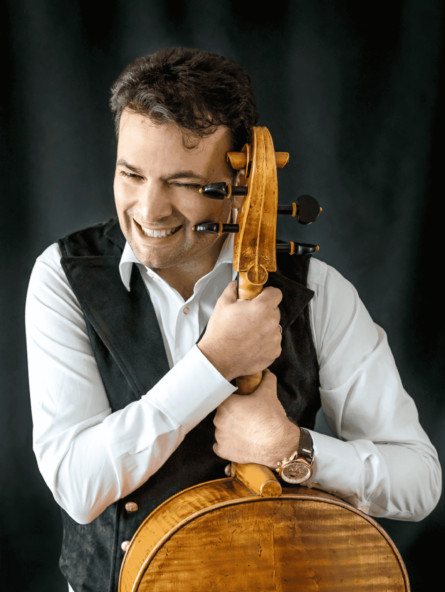
An international concert cellist and a catalyst for new works, Sébastien Hurtaud has forged a distinctive path in which the great solo repertoire enters into dialogue with new music, literature, history and memory. A humanist conviction runs through his career: that music can bridge eras, cultures and generations, and give new voice to stories that time threatens to erase.
Hurtaud enjoys the support of pianist and conductor Philippe Entremont, whose career has crossed paths with many of the greatest soloists of the twentieth century, and who regards him as one of the most gifted cellists of his generation and an heir to the international influence of the great French school. A laureate of the Naumburg International Cello Competition in New York, Hurtaud went on to win First Prize and the Bach Prize at the Adam International Cello Competition in New Zealand. His playing and recordings have drawn the attention of BBC Music Magazine, The Strad, Fanfare, Pizzicato, Crescendo, BBC Radio 3, Classic FM, Radio France, RNZ, Radio Canada and RTS, among others. This French lineage is also reflected in his association with Claude Bolling, with whom he performs the Suite for Cello and Jazz Piano Trio, joining a musical history that includes Jean-Pierre Rampal and Yo-Yo Ma.
Commissioning new music is inseparable from his identity as a performer. An early encounter with Mstislav Rostropovich crystallised the idea: seek out composers and bring tomorrow’s repertoire into being, even if it means, in the image that stayed with Hurtaud, “sleeping on their doormat” until they write for him. Hurtaud does not simply receive new scores; he sparks them, sometimes imagines their subject, and brings together a composer, a story and his instrument. Brazilian composer Antonio Santana dedicated L’Envol, inspired by the world of birds, to him, and his collaboration with Scott Ordway stems from the same quest. With Anthony Girard, this approach extends to musical heritage: captivated by a little-known early work by Maurice Ravel, Hurtaud invited Girard to imagine a new orchestral life for it and commissioned the Ballade for cello and orchestra, which he premiered in Korea before giving the French premiere with the Orchestre Victor Hugo. Their dialogue continues today with a new cello concerto in preparation, in the same spirit of bringing new works to life while giving the music of the past an unexpected concert life.
His solo career has taken him across Europe, the Americas, Asia and Australasia, from the great classical architectures to some of the most lyrical, dramatic and virtuosic pages of the cello literature: Haydn, Boccherini, Saint-Saëns, Dvořák, Elgar, Shostakovich, Strauss, Offenbach and Gulda, to name but a few. He has appeared with the New Zealand Symphony Orchestra, the Slovak Philharmonic, the Katowice Philharmonic, the Orchestre national de Metz, the Orchestre National de Bretagne, the Orchestre de Picardie and the Prime Philharmonic Orchestra, among others; under Arie van Beek, he performed Strauss’s Don Quixote on a European tour. His concert life has taken him from Wellington and Auckland to Tokyo and Seoul, from Moscow to Barcelona, from Panama to Chile, and to the United States, including Dallas, St. Louis and Minneapolis, as well as to settings as varied as Deauville, Musicalta, the Festival de Paris and the Malta International Baroque Festival. At the Moscow International House of Music, he also performed with Lucas Debargue in concerts connected with the International Tchaikovsky Competition.
Chamber music naturally extends this movement between stages and generations: Hurtaud has performed with Joaquín Achúcarro, Bruno Canino, Lana Trotovšek, Chloé Kiffer and Victoria Shereshevskaya. With pianist Paméla Hurtado he forms a long-standing duo, nurtured in particular by the Rachmaninoff Sonata and extended on record with Hindemith for Naxos; they are currently preparing new recordings.
This drive to bring new works into being has gradually joined a deeper inquiry into memory, exile and transmission. Hurtaud initiated Gareth Farr’s concerto Chemin des Dames, born of the shared memory of France and New Zealand during the First World War, which he premiered with the New Zealand Symphony Orchestra before recording it under Benjamin Northey, alongside the Elgar Concerto. With American composer Steve Heitzeg, Refugee, premiered with pianist Daniel Rieppel, explores exile and displacement; with artist and author Thomas Duranteau, Des miettes et des étoiles brings music, images and narrative to bear on the memory of the Holocaust, deportation and the camps; and with Ukrainian composer Youli Galperine, whose works he champions in Paris, this reflection also extends to spiritual resistance against Nazi barbarity.
Literature belongs to the same landscape. Hurtaud has devoted programmes to Katherine Mansfield and has performed for Gallimard around Akira Mizubayashi and La Forêt de flammes et d’ombres, in which war, music and memory intertwine. At La Seine Musicale, this meeting of literature and new music took another form with Claudio Alsuyet’s Le Messager de la nuit, inspired by Saint-Exupéry’s Night Flight, premiered with the Orchestre Lamoureux and the acclaimed actresses Judith Henry and Julie Gayet.
Sébastien Hurtaud is also developing a major new creative project in collaboration with Brendan Berne, former Australian Ambassador to France. He was previously artistic director of the Offenbach Festival in Étretat, where he fostered encounters between instrumental music, opera and theatre, notably with soprano Céline Byrne. His discography reflects the same eclecticism: alongside his recordings of Hindemith, Elgar and Farr, he took part in Evgueni Galperine’s Theory of Becoming for ECM New Series, while other projects have led him to the Nimbus Records Foundation in Great Britain.
Now professor of cello at the École Normale de Musique de Paris–Alfred Cortot, an institution historically linked to Pablo Casals, Sébastien Hurtaud in turn carries this continuity forward through teaching. He trained at the Royal Northern College of Music in Manchester with Karine Georgian, then at the Conservatoire National Supérieur de Musique de Paris with Jean-Marie Gamard and Erwan Fauré; in chamber music, he also studied with Réna Shereshevskaya.
From the great repertoire to the works he brings into being, from European memory to the cultures of the Pacific, Sébastien Hurtaud has built a career in which the cellist is not merely a performer, but a messenger, an inspirer and a creator of encounters.